
Last Updated on August 24, 2026 by Status.net Editorial Team
- Essential Techniques for an Effective Leadership Meeting (+ Free Agendas) Part 1
- Effective Leadership Meeting: Free Download Part 2
- Leadership Meeting Topics and Agenda Ideas Part 3
- Sample Leadership Meeting Agenda Part 4
- How Often Should Leadership Teams Meet Part 5
- Executive Team Meeting Agendas: What Sets Them Apart Part 6
- Common Mistakes That Undermine Leadership Meetings Part 7
- How to Take and Distribute Leadership Meeting Notes Part 8
Part 1Essential Techniques for an Effective Leadership Meeting (+ Free Agendas)
Leadership meetings are primarily conducted to make decisions and to ensure that the organization’s operation is aligned with its targets and goals. Apart from deciding on key issues, it is also through these meetings that business strategies are crafted to realize the organization’s goals and aspirations effectively.
A highly-productive leadership meeting is a great contributor to the success of an organization since this gathering is the place to produce excellent ideas and strategies. Participants should also look forward to attending these meetings, and leave them feeling energized and inspired.
On the other hand, poorly-prepared and poorly-conducted leadership meetings are a terrible waste of time. These meetings result in unresolved problems, poor decisions, and missed opportunities for the organization. Participants are left frustrated and demotivated.
Here are the key points to consider in order to run an effective leadership meeting:
-
1. The purpose of the meeting should be clear, not only to the organizers, but also to the coordinators and participants
The success of any meeting is directly linked to the clarity of its goals. Each leadership meeting should have explicitly defined objectives which tell everyone involved what the meeting is about, and what the expected results of the meeting are. That is, what is expected to be achieved or accomplished. Avoid listing agenda topics which involve daily operational issues or subjects which may be better addressed at a the lower level. A leadership meeting agenda should concentrate on strategic matters. For more techniques on preparing meeting agendas you can read this article.
-
2. Ensure that participants are well-prepared to attend the meeting
Reading reports on the day of the meeting itself is a waste of time. This should be done before the actual meeting. Take note that a leadership meeting is about decision-making and crafting business strategies and participants should come in armed with ideas, suggestions, and be ready to engage in a substantive discussion which will result in valuable results.
-
3. Meetings should be structured
A carefully-prepared meeting agenda will help bring structure and form to the meeting. It will guide everyone on which topics to discuss in order of priority and how long they should spend on a given topic. Leadership meetings are often thought to be serious and formal which makes it dreadful for some participants. Look for some leadership meeting ideas that will maintain participants’ interest and prevent their attention wandering due to boredom.
-
4. Acknowledge each participants’ contributions
Take advantage of the group’s diversity and reflect their different backgrounds, experiences, skills and expertise. These factors will help enrich the brainstorming process and, in turn, will contribute to creating innovative ideas. Establish a healthy environment for expressing ideas, sharing experiences, and asking questions. There are different brainstorming techniques that can be found in this article.
-
5. Take minutes to document everything that has been discussed
It is very important to record everything that has been reviewed and what the group was able to achieve after a meeting. This article is a good reference on how to prepare the minutes of the meeting.
-
6. Start and end the meeting on time
Leadership meetings tend to run long when the group is engaged, but starting late or letting discussions spill over sends the message that the schedule does not matter. A meeting that consistently ends on time trains participants to prepare in advance and to make decisions efficiently rather than dragging out debate. If a topic genuinely needs more time, park it for a follow-up conversation rather than letting it consume the rest of the agenda.
-
7. Review action items from the previous meeting before introducing new topics
Nothing erodes trust in a leadership meeting faster than watching the same commitments resurface unresolved, meeting after meeting. Open with a quick check on what was promised last time, who owned it, and whether it was completed. This habit alone often does more to improve meeting effectiveness than any agenda redesign.
-
8. Limit the number of agenda topics to what can be meaningfully discussed
A packed agenda that tries to cover ten topics in an hour usually results in shallow discussion on all of them. It is often more productive to cover three or four topics well than to rush through a longer list. If a topic keeps getting bumped, that is often a signal it needs its own dedicated session rather than a slot on a crowded agenda.
A leadership meeting is an opportunity for the top officials of an organization to gather and think of ways to improve performance and to further drive the firm towards success. Proper preparation and conduct will enable these meetings to achieve those goals.
Getting the agenda topics right matters as much as running the meeting well. The next sections cover what to put on a leadership meeting agenda, how often leadership teams should meet, and how to avoid the mistakes that quietly drain value from otherwise well-intentioned meetings.
Part 2Effective Leadership Meeting: Free Download


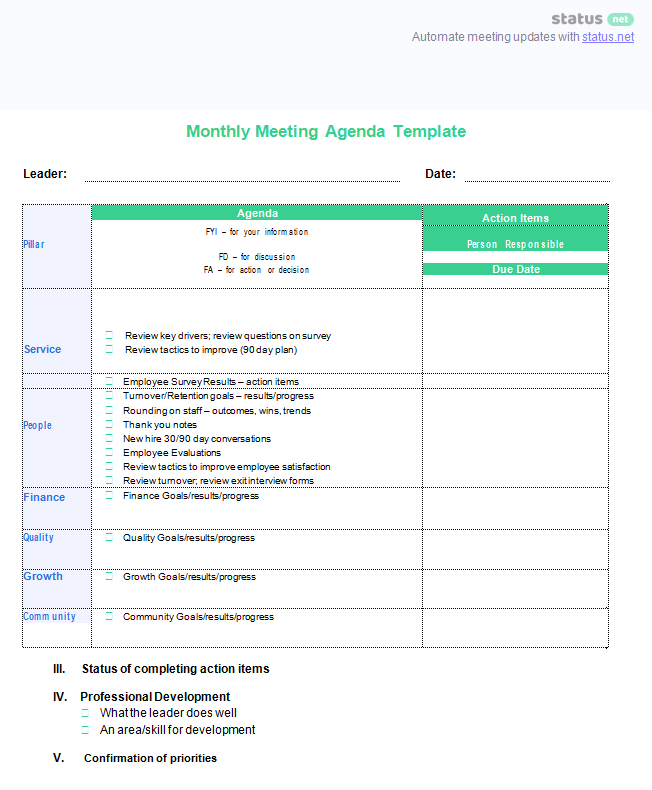
Click Here to Download Leadership Meeting Agenda Template DOCX


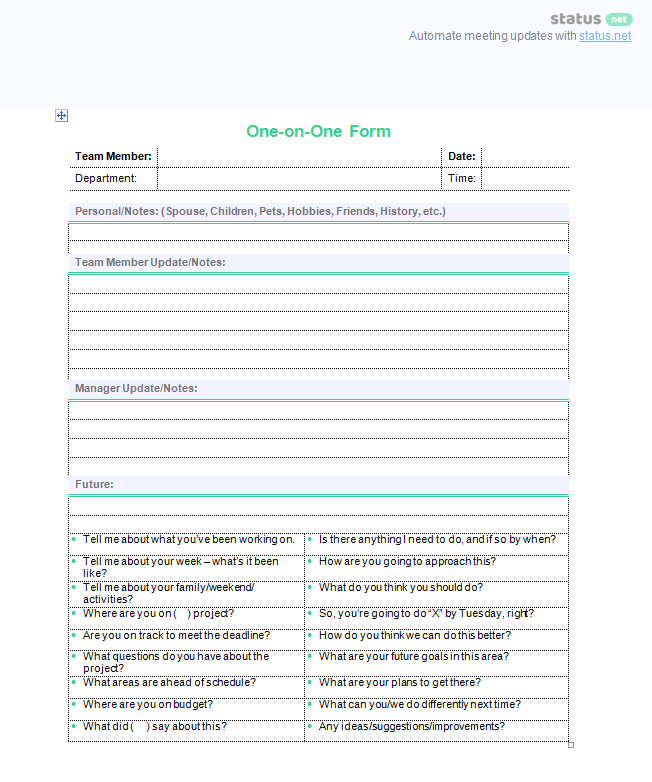
Click Here to Download Leadership Meeting Agenda Template 2 DOC
Part 3Leadership Meeting Topics and Agenda Ideas
Deciding what belongs on a leadership meeting agenda is often harder than deciding when to meet. The strongest leadership meeting topics push the group toward decisions, direction, and alignment. Status updates that could be shared in a written report rarely deserve a slot on the agenda.
When building out leadership meeting topics for an upcoming quarter, it often helps to draw from a recurring set of categories rather than starting from a blank page each time:
- Strategic planning and goal alignment – progress against annual or quarterly goals, and whether current priorities still reflect the direction the organization needs to move in.
- Performance metrics and KPI review – the handful of numbers that matter most to leadership, discussed with enough context to prompt a decision rather than just a status check.
- Financial and budget updates – spending trends, forecast variances, and any resource reallocation decisions the group needs to make.
- Risk management and contingency planning – emerging risks to the business, from operational disruptions to market shifts, and what the leadership team plans to do about them.
- Talent, succession planning, and organizational development – key hires, promotions, retention concerns, and readiness for future leadership needs.
- Culture, engagement, and communication – how initiatives are landing with employees, and what leadership needs to reinforce or adjust.
- Cross-departmental alignment and dependencies – issues that touch multiple teams and need leadership-level coordination to resolve.
- Customer and market insights – feedback, competitive movement, or industry shifts that could influence strategy.
- Innovation and new opportunities – ideas worth investing in, piloting, or shelving for now.
Not every category needs a slot on every agenda. A useful practice is to rotate topics so that recurring themes such as financial performance and talent get consistent attention, while other categories surface only when there is something genuinely worth deciding on.
Part 4Sample Leadership Meeting Agenda
Leadership teams often ask what a well-structured leadership meeting agenda actually looks like in practice. The right format depends on how frequently the group meets. A weekly leadership meeting agenda tends to be tighter and more tactical, while a monthly or quarterly leadership meeting agenda allows for deeper strategic discussion.
Sample Weekly Leadership Meeting Agenda
A weekly leadership meeting usually runs 45 to 60 minutes and focuses on keeping the organization aligned week to week.
- Welcome and quick wins (5 minutes) – a brief moment to acknowledge recent progress before diving into business.
- Review of action items from the last meeting (10 minutes) – status on prior commitments, with a clear owner and deadline for anything still open.
- Key metrics and performance review (10 to 15 minutes) – a short look at the handful of numbers leadership tracks weekly.
- Strategic discussion topic of the week (15 to 20 minutes) – one focused topic pulled from the categories above, discussed in enough depth to reach a decision.
- Roadblocks and support needed (5 minutes) – a chance for any leader to flag where they need help from the rest of the group.
- Action items and next steps (5 minutes) – a recap of who owns what before the next meeting.
Sample Monthly or Quarterly Leadership Meeting Agenda
Monthly or quarterly leadership meetings usually run longer, sometimes as a half-day or full-day session, and are built for deeper strategic work.
- Review of progress against quarterly goals or OKRs – an honest look at what is on track, what is behind, and why.
- Deep dive on one strategic priority – a topic that needs more than a 15-minute slot, such as a major initiative, market shift, or organizational change.
- Financial performance and budget review – a more detailed look at spending, forecasts, and resource decisions than a weekly meeting allows.
- Talent and organizational updates – hiring plans, succession planning, and any structural changes under consideration.
- Risk assessment – a review of risks that have emerged or shifted since the last session.
- Culture and engagement pulse check – how employees are experiencing recent changes or decisions.
- Decisions needed and next steps – a clear list of what was decided, what remains open, and who owns each follow-up.
These agendas work best as a starting point. Trim, reorder, or combine sections so that the agenda reflects what your leadership team actually needs to decide, rather than following a fixed format for its own sake.
Part 5How Often Should Leadership Teams Meet
There is no single cadence that works for every organization, but most leadership teams settle into one of a few patterns depending on the pace of the business and how much coordination is needed across departments.
- Weekly leadership meetings – common in fast-moving organizations, startups, or teams navigating active change, where alignment can break down quickly if leaders go too long between conversations.
- Biweekly leadership meetings – a middle ground for organizations that want regular check-ins but find weekly meetings generate more overhead than value.
- Monthly leadership meetings – suited to more established organizations where weekly tactical coordination happens elsewhere, and the leadership meeting is reserved for higher-level review.
- Quarterly leadership meetings or off-sites – typically layered on top of a shorter, more frequent cadence, used for longer-range planning, strategy resets, and topics that need extended, undistracted discussion time.
A practical approach many organizations use is a shorter weekly or biweekly sync for alignment and quick decisions, paired with a longer monthly or quarterly session for strategic planning. If leaders consistently leave meetings feeling like nothing was decided, that is often a sign the cadence and agenda length are mismatched with what the group actually needs to accomplish.
Part 6Executive Team Meeting Agendas: What Sets Them Apart
Executive team meetings and departmental leadership meetings share a similar structure, but the scope of an executive team meeting agenda tends to sit at a higher altitude. Where a departmental leadership meeting might focus on that team’s goals and execution, an executive team meeting agenda typically covers topics that affect the entire organization.
Executive team meetings often include:
- Enterprise-wide strategy and priorities – decisions that affect multiple departments or the organization as a whole.
- Cross-functional dependencies and conflicts – issues where two or more departments need executive intervention to move forward.
- Organization-wide risk and resilience – risks that span beyond a single department’s control.
- Board and investor updates – preparation for or follow-up from conversations with the board or other external stakeholders.
- Culture and leadership bench strength across the organization – succession planning and leadership development at the enterprise level.
If your organization runs both a departmental leadership meeting and a separate executive team meeting, it helps to be explicit about which topics belong in each. Otherwise, the same conversation tends to happen twice, once at each level, without much added value the second time around.
Part 7Common Mistakes That Undermine Leadership Meetings
Even experienced leadership teams fall into patterns that quietly erode the value of their meetings over time. Watching for these patterns often does more to improve leadership meeting effectiveness than any single agenda template.
- Letting status updates crowd out strategic discussion. If most of the meeting is spent reporting on what already happened, move those updates to a shared document and reserve meeting time for decisions.
- No clear owner for each agenda topic. Every topic should have someone responsible for framing the discussion and driving it toward a decision, rather than leaving it to whoever happens to speak up.
- Skipping the follow-up on previous action items. When commitments are never revisited, participants learn that deadlines discussed in the meeting are optional.
- Overloading the agenda. Trying to cover too many topics leads to shallow discussion and decisions made under time pressure.
- Allowing one or two voices to dominate. A leadership meeting works best when the group’s collective judgment is used. A facilitator who actively invites input from quieter members helps surface perspectives that would otherwise be lost.
- Treating every meeting as equally important. Some weeks genuinely have little to discuss. Canceling or shortening a meeting when there is no substantive agenda respects everyone’s time more than filling the slot out of habit.
- No mechanism for tracking decisions over time. Without a running record, the same debates resurface months later because nobody remembers what was already decided and why.
Part 8How to Take and Distribute Leadership Meeting Notes
Leadership meeting notes serve a different purpose than a full transcript. The goal is to capture what was decided, who owns each follow-up, and any open questions that need resolution, not to document every comment made during the discussion.
A useful set of leadership meeting notes typically includes:
- Attendees and date. A quick record of who was present and who was absent, in case a decision needs to be revisited with someone who missed the discussion.
- Key decisions made. Each decision stated clearly enough that someone who was not in the room could understand what was agreed upon.
- Action items with owners and deadlines. Vague notes such as “follow up on budget” are far less useful than “Maria to finalize Q3 budget by Friday.”
- Open questions or unresolved topics. Anything the group could not fully resolve, along with when it will be revisited.
- Topics deferred to a future meeting. A short list so nothing important quietly falls off the radar.
For distribution, sending notes within 24 hours of the meeting keeps commitments fresh in everyone’s mind. Storing notes in a shared, searchable location rather than scattered across individual inboxes makes it far easier to track decisions over time and to answer the inevitable “wait, didn’t we already discuss this?” question a few months later.
Frequently Asked Questions
What should be on a leadership meeting agenda?
A leadership meeting agenda works best when it focuses on decisions, direction, and alignment rather than routine status updates. Strong agendas typically include a review of prior action items, a small number of strategic topics such as performance metrics, financial updates, risk, or talent planning, and a clear close where next steps and owners are confirmed.
How long should a leadership meeting be?
Weekly leadership meetings often run 45 to 60 minutes, which is enough time to review progress and discuss one or two strategic topics in depth. Monthly or quarterly leadership meetings tend to run longer, sometimes a half-day or full day, since they cover broader strategic planning that needs more room for discussion.
How often should leadership teams meet?
Most leadership teams meet weekly or biweekly for tactical alignment, often paired with a monthly or quarterly session for deeper strategic planning. The right cadence depends on how quickly the business is changing and how much cross-team coordination is needed. Organizations in periods of rapid growth or change often benefit from meeting more frequently.
What is the difference between a leadership meeting and an executive team meeting?
A departmental leadership meeting typically focuses on that team’s own goals, performance, and execution. An executive team meeting agenda usually covers topics that affect the whole organization, such as enterprise-wide strategy, cross-functional dependencies, board updates, and organization-wide risk.
Who should attend a leadership meeting?
Attendance should be limited to those whose input is needed for the decisions on the agenda. A leadership meeting that includes too many participants often slows decision-making and dilutes accountability. If certain topics only concern part of the group, consider handling them in a smaller follow-up conversation instead of the full meeting.
How do you keep a leadership meeting from turning into status updates?
Move routine reporting into a shared written update that participants review before the meeting, and reserve meeting time for topics that require discussion or a decision. Opening each agenda item with a specific question, such as “what do we need to decide here,” helps keep the conversation focused on outcomes rather than recaps.
What topics should be avoided in leadership meetings?
Day-to-day operational issues that a department can resolve on its own generally do not belong on a leadership meeting agenda. If a topic keeps coming up but never leads to a strategic decision, it is often better handled outside the leadership meeting or delegated to the team closest to the work.
How do you write effective leadership meeting notes?
Focus on capturing decisions made, action items with clear owners and deadlines, and any open questions rather than a full transcript of the discussion. Sending notes out within a day of the meeting and storing them somewhere searchable makes it much easier to track commitments and revisit past decisions.
-
…
-

…
-

…
-
…
-

…
-

…