
Last Updated on August 24, 2026 by Status.net Editorial Team
- One on One Meeting Template: Free Download Part 1
- 1-2-1, One-to-One, and One-on-One Explained Part 2
- Sample One-on-One Meeting Questions Part 3
- Building a Strong One-on-One Meeting Agenda Part 4
- Weekly, Biweekly, or Monthly One-on-Ones Part 5
- Using Tools and Software for One-on-Ones Part 6
- Common Mistakes That Undermine One-on-Ones Part 7
- Preparing for a One-on-One as an Employee Part 8
Open and frequent communication is the key to any relationship. It is especially important to a manager or supervisor and their direct reports, and this is usually achieved through one on one meetings. This article helps you prepare for this type of meeting by providing sample questions and a high quality one on one meeting template.
A supervisor usually conducts a one-on-one meeting with a staff member to find out how they are at that moment. It is also done to keep track of the employee’s performance and if they are meeting their targets and goals. A 1-on-1 is an excellent opportunity to discuss any problems or issues that are hindering the employee from achieving their goals.
On the part of the supervisor, the one-on-one meeting is a great opportunity to conduct coaching and to provide feedback to a staff member.
The value of these meetings lies in the fact that they present an opportunity for the supervisor and the employee to communicate on a personal level. This increases the employee’s feeling of involvement and allows them to feel more confident in performing their job.
The interval between meetings shouldn’t be more than two weeks. However, if the circumstances within the organization mean this is not possible, no longer than one month should elapse between meetings. The meetings shouldn’t take more than 30 minutes, and should not be take an excessive amount of the supervisor’s or the employee’s time.
Here are some ways on how to make one-on-one meetings productive:
- Have a regular schedule for the one-on-one meetings and commit to it. While meeting on an ad-hoc basis can sometimes be a good idea, the supervisor and the employee will be much better prepared for the meeting if they know when it is going to happen in advance. There may be times that the one-on-one meeting will need to be rescheduled due to other pressing matters. If it’s necessary to change the time of a meeting, it’s important that supervisors don’t make their staff feel that their meeting is a dispensable part of the schedule.
- The supervisor should not dominate the discussion. This session is conducted to monitor how the employee is doing and to clarify anything that may seem vague to them. The key to making this one-on-one meeting as effective as possible is to allow both the supervisor and the employee to feel comfortable. The supervisor can get the most out of it by making the conversation less formal and thus more substantive.
- Encourage the employee to raise issues. This way, both the supervisor and employee can think of ways to better address any problems.
- Document everything discussed during the meeting by using a one on one meeting template. Using a template will makes the job easier. The template is structured into fields, columns, and rows that the supervisor can complete instead of having to write a full narrative of the discussion. One-on-one meeting templates may be in Word or Excel formats, depending on which option the supervisor prefers to use. The organization may also prescribe a uniform template to be used by everyone.
Lastly, the supervisor should give the employee his full, uninterrupted attention during the one-on-one meeting.
A question that comes up often is how the right cadence should be chosen, and whether it should change depending on the employee or the team. In practice, the schedule tends to shift as the working relationship matures.
- New employees or employees in a new role often benefit from a weekly one-on-one for the first few months, since there is more to learn and more room for early misunderstandings that are easier to catch when caught early.
- Experienced employees in a stable role can often move to a biweekly or monthly cadence, as long as the supervisor stays available for a short ad-hoc check-in when something urgent comes up between scheduled meetings.
- Supervisors with large teams sometimes find a weekly one-on-one with every direct report unrealistic. A monthly meeting paired with brief informal check-ins during the week can keep the relationship strong without overwhelming the supervisor’s calendar.
Whatever cadence is chosen, consistency tends to matter more than frequency. An employee who can count on a monthly meeting that reliably happens is often better supported than one whose “weekly” meeting gets rescheduled every other week.
One-on-one meetings also do not need to happen in person to be productive. Video calls work well for remote or hybrid teams, as long as both people commit to staying focused during the conversation and avoid multitasking. What matters most is protected, uninterrupted time, whether that happens across a desk or over a video call.
Part 1One on One Meeting Template: Free Download
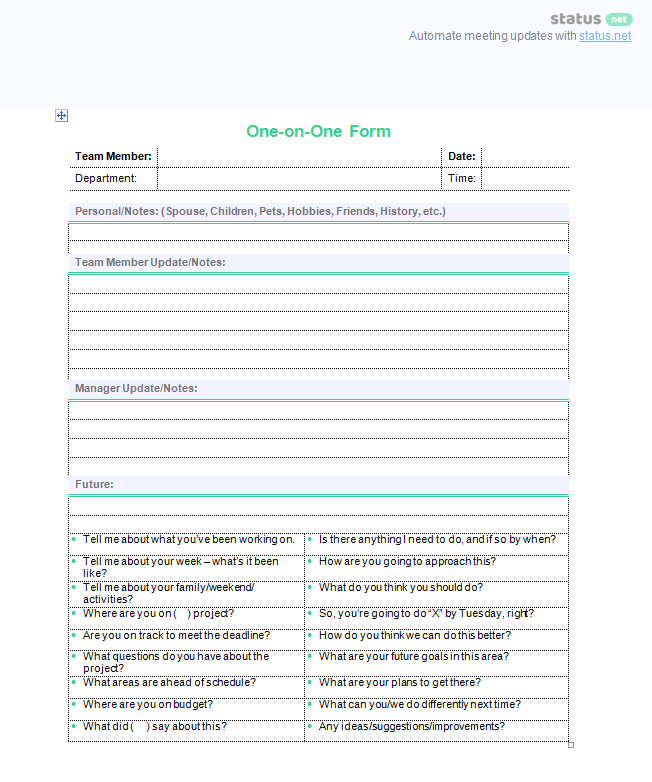
Click Here to Download One On One Meeting Agenda Template DOCX


Sample Questions: Click Here to Download One On One Meeting DOC
These templates work as a starting point rather than a rigid form. Many supervisors keep a Word version for typing notes during the conversation and a printable version for employees who prefer to jot down thoughts by hand before the meeting starts. If your organization tracks one-on-ones in a spreadsheet across a whole team, the same fields can be adapted into an Excel layout so that a supervisor managing several direct reports can scan trends across employees at a glance.
A few practical notes on choosing a format:
- Word or DOC templates work well when the supervisor wants to type detailed notes during the conversation and keep a running document per employee over time.
- PDF templates are useful when the form needs to stay fixed, for example when it is printed and handed out ahead of the meeting or filed as a record.
- Excel or spreadsheet templates suit supervisors managing many direct reports who want to compare notes, goals, or action items across the whole team in one place.
- Printable templates give employees who prefer paper the chance to prepare notes and questions before sitting down, which can make the conversation feel less rushed.
Part 21-2-1, One-to-One, and One-on-One Explained
The same conversation goes by several names depending on where you work. Organizations in the United States tend to say “one-on-one,” while many UK and Commonwealth workplaces refer to the same meeting as a “1-2-1” or “one-to-one.” A staff “1-2-1” and a supervisor “one-on-one” describe the identical practice: a regular, private conversation between a supervisor or manager and one direct report.
The terminology can also shift by function. A “supervision meeting” often refers to the same format used in social care, education, and nonprofit settings, where regular one-to-one supervision is part of how staff receive support and guidance. Whatever label your organization uses, the template and agenda structure described in this article work the same way. There is no need to search for a separate “1-2-1 template” or “supervision meeting template” if you already have a solid one-on-one meeting template. The fields simply need renaming to match your organization’s preferred term.
Part 3Sample One-on-One Meeting Questions
A blank agenda can feel intimidating for both the supervisor and the employee, especially in the first few meetings. Having a bank of questions ready makes it easier to keep the conversation moving without turning it into an interrogation. The goal is to pick two or three questions that fit the moment rather than working through every question on every list.
Questions About Performance and Goals
- What progress have you made on your goals since our last meeting?
- Is there anything blocking you from hitting your targets this month?
- Which of your current priorities feels most at risk, and why?
- What would make the biggest difference to your output this week?
- Is there a task on your plate that no longer makes sense to keep doing?
Questions About Career Growth and Development
- What skills would you like to build over the next few months?
- Is there a project you would like more exposure to?
- How do you feel about your current growth in this role?
- What would you want to be doing a year from now?
- Is there training or mentoring that would help you get there?
Questions About Wellbeing and Workload
- How has your workload felt over the past couple of weeks?
- Is there anything outside of work affecting how you’re showing up here?
- What part of your week feels the most draining right now?
- Do you feel like you have enough support from the team?
- Is there anything I could take off your plate?
Questions Employees Can Ask Their Manager
A one-on-one works best when it flows in both directions. Employees who prepare a few questions of their own often get more out of the meeting than those who wait to be asked things.
- Is there anything about my recent work you’d want me to do differently?
- What are the team’s priorities for the next month that I should know about?
- Is there a skill you think I should focus on developing?
- How is my work landing with other stakeholders or teams?
- Is there anything happening at a higher level that might affect our team?
Part 4Building a Strong One-on-One Meeting Agenda
A template captures what was said, while an agenda decides what gets talked about in the first place. The strongest one-on-one meeting agendas share a similar shape even when the specific questions change from week to week.
A Simple Agenda Structure That Works
- Check-in (2 to 5 minutes). A brief, informal opening about how the employee is doing. This is not the place for status updates. It is a moment to connect as people before moving into the working part of the conversation.
- Employee’s topics (10 to 15 minutes). Whenever possible, let the employee lead this part. Ask what they want to talk about, rather than starting with the supervisor’s list. This single shift tends to make the meeting feel less like a status report and more like genuine support.
- Supervisor’s topics (5 to 10 minutes). Feedback, coaching notes, or updates the supervisor needs to share. Keep this focused rather than turning it into a long list of items.
- Goals and development (5 minutes). A quick look at longer-term goals so the day-to-day conversation stays connected to where the employee wants to grow.
- Action items and next steps (2 to 5 minutes). Confirm what each person is committing to before the next meeting, and write it down in the template so it does not get lost.
Not every meeting needs all five sections in full. A weekly one-on-one might spend most of its time on the employee’s topics and skip the goals discussion most weeks, while a monthly one-on-one often needs more time on goals and development since there is more ground to cover since the last conversation.
Adapting the Agenda for Coaching or Check-Ins
Some one-on-ones are built around coaching rather than a general check-in. A coaching-focused one-on-one usually spends less time on status updates and more time helping the employee think through a specific challenge, decision, or skill gap. A coaching form or template often adds fields for the situation being discussed, what the employee has already tried, and what options remain, rather than the general topic and action item fields found in a standard one-on-one template.
A lighter “check-in” version of the meeting works well for teams that already communicate often through other channels. A check-in template can drop the career and development section most weeks and focus on a short pulse check: how the employee is doing, whether anything is blocking their work, and whether they need anything from the supervisor before the next scheduled conversation.
Part 5Weekly, Biweekly, or Monthly One-on-Ones
The right frequency depends less on a fixed rule and more on the size of the team, the employee’s experience, and how much change is happening in the work itself.
- Weekly one-on-ones suit fast-moving roles, new employees, or situations where priorities shift often enough that a monthly conversation would leave too much unaddressed in between. A weekly template can stay short, focused mainly on current blockers and quick wins.
- Biweekly one-on-ones often hit a comfortable middle ground for established employees in steady roles. There is enough time between meetings for real progress to happen, but not so much that small issues turn into bigger ones before they get addressed.
- Monthly one-on-ones tend to work for senior employees who need less day-to-day oversight, or for supervisors managing a larger group where a more frequent schedule is not realistic. A monthly template usually benefits from a dedicated section reviewing goals and development, since more ground needs to be covered in a single sitting.
Teams sometimes mix cadences, running a short weekly check-in alongside a deeper monthly conversation that uses a more detailed template. This can work well as long as both meetings have a clear, distinct purpose so the weekly check-in does not just become a shorter, worse version of the monthly meeting.
Part 6Using Tools and Software for One-on-Ones
A printed or downloaded template works well for supervisors managing a handful of direct reports. As team size grows, many supervisors move toward a shared document or spreadsheet that both people can edit before the meeting, so agenda items are not decided entirely by the supervisor at the last minute.
- A shared document that both the supervisor and employee can add to during the week often produces a richer agenda than one built entirely in the meeting itself.
- Keeping a running history of notes, rather than starting a fresh document every time, makes it easier to spot patterns, like a recurring blocker or a goal that keeps slipping.
- Calendar reminders tied to the meeting can help prompt both people to jot down a topic or question before the conversation starts, rather than arriving with nothing prepared.
Whatever system is used, the tool should support the conversation rather than take attention away from it during the meeting itself. A supervisor typing extensively during a sensitive conversation can unintentionally make an employee feel like they are being evaluated rather than heard.
Part 7Common Mistakes That Undermine One-on-Ones
Even well-intentioned supervisors fall into a few predictable patterns that quietly drain the value out of these meetings over time.
- Turning it into a status meeting. If the entire conversation is spent reviewing task lists, the employee has little reason to bring up anything personal or developmental. Save pure status updates for a different forum when possible.
- Canceling too often. A meeting that gets bumped repeatedly sends a signal about where the employee ranks on the supervisor’s priority list, even if that is not the intention.
- Using the same questions every single time. Repetition can make the meeting feel routine. Rotating between performance, growth, and wellbeing questions keeps the conversation fresh.
- Never following up on action items. If commitments made in one meeting are never mentioned again, employees learn that the meeting does not lead to real change.
- Treating every employee the same way. A template gives structure, but the tone, pace, and depth of the conversation should flex to fit the individual sitting across from you.
Part 8Preparing for a One-on-One as an Employee
Employees who show up with a short list of topics tend to get more out of the meeting than those who wait for the supervisor to drive the entire conversation. A few minutes of preparation beforehand can change the tone of the whole meeting.
- Jot down one or two wins from the past week or month, along with anything that felt harder than expected.
- Note any blockers that need the supervisor’s help to resolve, along with what has already been tried.
- Bring at least one question about growth, priorities, or feedback, rather than only reporting on completed tasks.
- If something has been building up, whether a frustration or a concern, a one-on-one is often a better setting to raise it than a group meeting or a passing hallway conversation.
It also helps to remember that the meeting belongs to both people. A supervisor asking “what would you like to talk about?” at the start of the meeting is inviting genuine input, not just being polite.
Frequently Asked Questions
What does “1:1” mean in the workplace?
“1:1” is shorthand for a one-on-one meeting, a regular private conversation between a supervisor or manager and a single direct report. It covers the same ground as a “one-on-one,” “1-2-1,” or “one-to-one” meeting; the shorthand is just a faster way of writing it on a calendar invite.
What is the “one-on-one method” that management experts recommend?
Several well-known management frameworks recommend a similar approach: hold the meeting on a fixed, recurring schedule, let the employee set most of the agenda, and use the time for coaching and career conversations rather than status reporting. The exact structure varies by framework, but the underlying idea is consistent: the meeting works best when it is protected, predictable, and led primarily by the employee’s needs rather than the supervisor’s checklist.
How long should a one-on-one meeting last?
Most one-on-ones run between 15 and 30 minutes. Shorter, weekly check-ins can work well at 15 minutes, while a monthly meeting covering goals and development often benefits from the full 30 minutes. Meetings that regularly run much longer than 30 minutes may need a tighter agenda rather than more time.
Who should set the agenda, the manager or the employee?
A shared agenda tends to work best, with the employee contributing most of the topics. Supervisors who fill the entire agenda themselves risk turning the meeting into a one-directional update rather than a genuine conversation.
Should HR or another manager sit in on a one-on-one meeting?
In most cases, a one-on-one works best as a private conversation between the supervisor and the employee. Having a third person sit in can make the employee less willing to raise concerns openly. There are exceptions, such as a new supervisor shadowing an experienced one to learn the format, but this is usually explained to the employee in advance rather than sprung on them.
Should one-on-one meetings happen in person or over video call?
Either format can work well. What matters most is that both people are fully present, with notifications silenced and no other tasks competing for attention during the conversation. Teams that are fully remote or hybrid often find video calls work just as well as an in-person meeting, as long as cameras stay on and the conversation is not rushed.
What is the difference between a one-on-one and a performance review?
A performance review is typically a formal, periodic evaluation tied to ratings, compensation, or documented performance history. A one-on-one is an ongoing, informal conversation focused on day-to-day support, coaching, and relationship-building. Strong one-on-ones over the course of a year often make performance reviews easier, since there are fewer surprises by the time the formal review happens.
How should notes from a one-on-one meeting be taken?
Many supervisors keep a running document per employee, adding a few lines after each meeting rather than trying to capture a full transcript. Recording action items clearly, along with who owns each one, makes it much easier to follow up at the next meeting.
What if an employee says they have nothing to discuss?
This happens often, especially with newer employees who are still building trust in the format. A few prepared questions from the sample lists above can help fill the space without pressuring the employee. Over time, as trust builds, employees typically start bringing their own topics without needing to be prompted.
How often should one-on-one meetings happen?
Weekly or biweekly meetings work well for most employees, with monthly meetings suiting senior employees or supervisors managing larger teams. The interval between meetings should not exceed one month in most cases, since longer gaps make it harder to catch small issues before they grow.
-

…
-

…
-

…
-

…
-

…
-

…