
Last Updated on August 24, 2026 by Status.net Editorial Team
- Scrum Status Report: Free Download Part 1
- What a Scrum Status Report Should Include Part 2
- Sprint Report Templates for Agile Teams Part 3
- Scrum Master Reporting Responsibilities Part 4
- How Often to Send Scrum Status Reports Part 5
- Common Mistakes in Scrum Status Reporting Part 6
- Tips for Writing Effective Scrum Reports Part 7
In writing a scrum status report, one thing to consider is it should be able to update the stakeholders on the progress of the project that builds business value and to give an account of value the team delivers to the project such as developing features and satisfying requirements.
There are, typically, four types of reports in Scrum at the end of each iteration:
-
Product Backlog
Listing all features of products, this report serves as a repository of all main requirements for the product development. It’s also in here where conversations between the team, product owner, and other stakeholders go on record.
The features requested by the client are listed using a one-line description, and all the other explanation or description about the requested feature are recorded separately and are not included in this particular report.Also, the Product Backlog should update frequently from the changes on each part of the scrum project management cycle.A) The pre-project/kick-off meeting, where someone creates the product backlog.
B) Sprint planning meeting, where the team select items for sprint development.
C) Sprint, where the features develop.
D) Sprint review meeting/retrospective, where all feedback about functionality is gathering and recording. -
Sprint Backlog
Being a subset of the product backlog, the sprint backlog is a list of functionality or feature which will be developing during a specific iteration, as opposed to having all the features of the entire product.
This is also where the stories to be developed during that particular iteration are selected by the team and are updated regularly to reflect the team’s progress.
-
Changes Report
The Changes Report is an important documentation of all added, deleted, or modified features while the project is being implemented. This is where all adjustments or alterations go and also get approval from the product owner.
For this report, it is advisable to use a spreadsheet or bulleted-points as this document can also serve as a reference for audit purposes or budget liquidation. It is important to include the changes report in a scrum since it provides a historical documentation of all modifications approved by the product owner, or anybody designated to decide on behalf of the client. -
Burndown Chart
A graph representing work performed or ‘burned down’ since the project started, a burndown chart allows the team to see how far or near they are toward the project completion. Unlike the changes report, it includes all features and functionalities for development and not only those for the current Sprint.
At one glance, a burndown chart gives an overall status of the project or product development and it can serve as ready reference for those people who do not have an access to the scrum but are interested to know about the updates on the project.Some teams pair the burndown chart with a burnup chart, which plots completed work against total scope on the same axis. A burnup chart makes scope changes easier to spot, since added or removed backlog items shift the total-scope line instead of hiding inside the remaining-work calculation. This distinction matters most on longer projects where the client adds requirements mid-stream, because a burndown chart alone can make it look like the team is falling behind when the real cause is scope growth.
One main benefit of the agile method is that it encourages open communication and collaboration between the project team and the product owner, so do not forget to establish and maintain those to fully benefit to what the agile method has to offer.
Beyond these four core documents, many scrum teams also track a handful of supporting reports that make the numbers above easier to interpret for people outside the daily standup.
- Velocity report: tracks how many story points or tasks the team completes per sprint, which helps with forecasting how much work fits into future sprints.
- Sprint report: a summary produced at the close of each sprint that pairs completed work with a short narrative on what went well and what got in the way.
- Impediment log: a running list of blockers the scrum master is actively working to remove, often shared during or right after the daily standup.
None of these replace the product backlog, sprint backlog, changes report, or burndown chart described above. They give stakeholders a faster way to gauge project health without digging through raw backlog data.
Part 1Scrum Status Report: Free Download
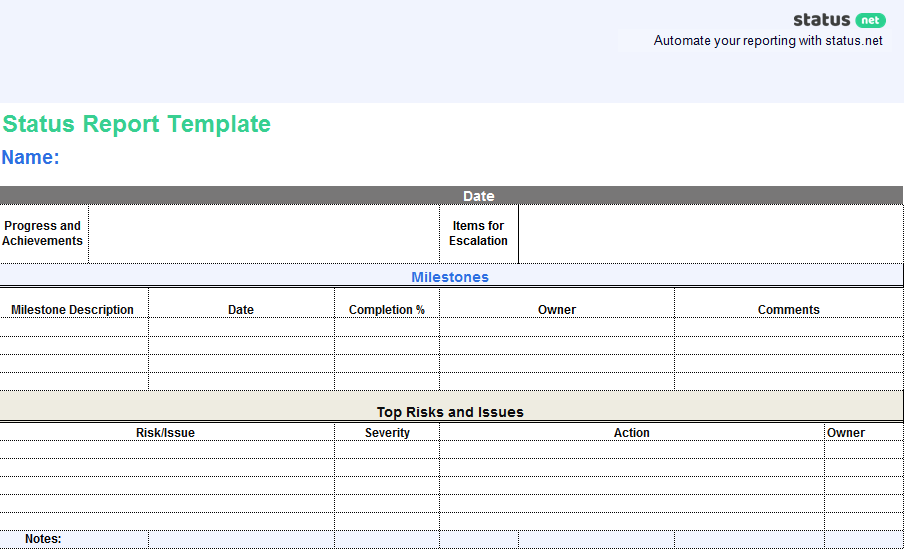
Download Status Report Template XLSX
This spreadsheet works well as a general-purpose starting point. Open it in Excel or import it into Google Sheets, then adjust the columns to match whichever report type your team needs that week, whether that is a sprint summary, a changes log, or a simple weekly update for stakeholders who never attend a standup.
A few practical adjustments make the template fit scrum work more closely:
- Add a column for the sprint number or sprint goal so readers know which iteration the report covers.
- Include a short blockers section near the top of the sheet, since impediments are often the first thing stakeholders and scrum masters want to see.
- Keep a running total of completed story points if your team measures velocity, so trends stay visible across several report cycles instead of resetting every time.
Part 2What a Scrum Status Report Should Include
A scrum report earns its place on a stakeholder’s desk when it answers three questions quickly: what got done, what stands in the way, and what happens next. Everything else is supporting detail.
Whatever format you land on, a solid scrum status report usually covers:
- Sprint goal: the single outcome the team committed to for the current iteration, stated in plain language.
- Work completed: stories, tasks, or bugs finished since the last report, ideally linked back to backlog items.
- Work in progress: what the team is actively building right now, so readers know it is not forgotten.
- Blockers and risks: anything slowing the team down, along with who owns resolving it.
- Key metrics: velocity, burndown trend, or cycle time, depending on what your organization tracks.
- Next steps: what the team plans to tackle before the next report goes out.
Skip any section that has nothing new to say that week rather than padding it with filler. A report that repeats last week’s status word for word trains readers to stop opening it.
Part 3Sprint Report Templates for Agile Teams
A sprint report template narrows the focus to a single iteration. Where the burndown chart shows a visual trend and the product backlog holds the full list of requirements, a sprint report tells the story behind the numbers in a few short paragraphs.
Core Sections of a Sprint Report
Most sprint report templates follow a similar shape, regardless of the tool used to build them:
- Sprint number, dates, and the team involved.
- Sprint goal and whether it was met, partially met, or missed.
- Completed stories versus planned stories, often shown as a simple ratio or percentage.
- Carryover items and a short note on why they slipped.
- Lessons from the retrospective that will change how the next sprint runs.
Keeping this structure consistent from sprint to sprint makes it far easier for a product owner or executive sponsor to compare progress over time, rather than having to re-learn the format every two weeks.
Adapting a Template for Sprint Reporting
If you are searching for a sprint report template free download, the status report template linked above adapts well with a few tweaks. Rename the header row to reflect the sprint number and goal, replace the generic task list with a completed-versus-planned comparison, and add a short retrospective note at the bottom.
Teams that run several sprints in parallel, across more than one product line, often find it worth keeping a separate tab or sheet per team so the metrics do not get blended together and lose their meaning.
Part 4Scrum Master Reporting Responsibilities
The scrum master usually owns the reporting rhythm for the team, even when someone else, such as the product owner, is the one presenting numbers to leadership. Scrum master reports tend to focus less on feature detail and more on team health and flow.
Metrics Scrum Masters Track and Report
- Velocity: story points or tasks completed per sprint, tracked over several iterations to spot trends rather than reacting to a single sprint.
- Sprint burndown: remaining work versus time left in the sprint.
- Cycle time: how long it takes a story to move from “in progress” to “done,” which flags process friction earlier than velocity alone.
- Impediment resolution time: how quickly blockers get cleared once they are raised.
- Team capacity: planned availability for the sprint, factoring in vacations, holidays, or support rotations.
A scrum master who reports on capacity alongside velocity gives stakeholders a much more honest picture of why a sprint under-delivered. A dip in output tied to two team members being on leave reads very differently from a dip caused by unclear requirements.
Daily Standups and Scrum Master Reports
The daily standup is not a formal report, but it feeds directly into one. Many scrum masters keep a running note during standup, listing blockers as they come up, and turn that note into the impediment section of the next status report without having to reconstruct it from memory.
This habit also protects the team from repeating the same blocker week after week without anyone noticing a pattern. A blocker that shows up in three consecutive standups is a strong signal that it belongs in the retrospective, not just the daily notes.
Part 5How Often to Send Scrum Status Reports
Reporting cadence depends heavily on the audience:
- Daily: informal standup notes for the team and scrum master, focused on blockers and today’s plan.
- Weekly: a short summary for stakeholders who do not attend standups but want a pulse check on progress.
- End of sprint: the full sprint report, tying completed work back to the sprint goal and noting anything carried over.
- Release or milestone: a rollup report that summarizes several sprints for leadership or the client.
Sending reports more often than the audience needs them tends to backfire. Executives who receive a daily update usually stop reading it within a few weeks, while a well-timed weekly or sprint-based report holds their attention because it always has something new to say.
Part 6Common Mistakes in Scrum Status Reporting
- Too much technical detail: a stakeholder report full of ticket numbers and branch names loses non-technical readers within seconds. Save that level of detail for the team’s own tracking tool.
- No connection to business value: listing “completed 14 stories” means little without a sentence on what those stories unlock for the customer or the business.
- Burying the blockers: if a report only mentions a critical impediment on page three, most readers will miss it. Put it near the top instead.
- Inconsistent format: switching the report layout every sprint forces readers to hunt for information they used to find in the same spot.
- Reporting activity instead of outcomes: “the team held three meetings” says nothing about progress toward the sprint goal.
Part 7Tips for Writing Effective Scrum Reports
- Write the sprint goal and its status first, then follow with supporting detail. Readers scanning quickly should get the headline in the first sentence.
- Tailor the level of detail to the audience. A product owner may want story-level detail, while an executive sponsor usually just needs the goal, the trend, and any risk.
- Keep the same template from sprint to sprint. Familiarity with the layout lets readers focus on what changed instead of relearning the structure.
- Use a chart or graph, such as a burndown or velocity trend, whenever a visual will communicate a trend faster than a paragraph of text.
- Close every report with a clear next step, even a small one, so readers know the team’s plan without having to ask.
Frequently Asked Questions
What is a scrum status report used for?
A scrum status report keeps the product owner and other stakeholders informed about sprint progress, completed work, and anything blocking the team, without requiring them to sit through daily standups or dig through the backlog themselves.
What should a scrum master include in a status report?
A scrum master’s report typically focuses on team health and flow rather than feature detail. That usually means velocity, sprint burndown, cycle time, capacity for the sprint, and a short note on current blockers and who owns resolving each one.
What is the difference between a sprint report and a status report?
A sprint report covers one specific iteration in depth, comparing planned work against completed work and noting what carried over. A status report is broader and can cover any time period, often summarizing several sprints or the overall project for an audience that only needs the highlights.
How often should scrum status reports be sent?
Cadence depends on the audience. Teams often keep informal notes daily, send a short summary weekly for stakeholders outside the team, and produce a full sprint report at the close of each iteration. Milestone or release reports usually roll up several sprints for leadership.
What metrics belong in a scrum report?
Velocity, sprint burndown trend, and cycle time cover most reporting needs. Teams tracking release health may also add capacity, impediment resolution time, and a completed-versus-planned ratio for the sprint.
Can the same template work for daily standups and sprint reviews?
A single flexible template can support both if it has swappable sections. Daily notes usually only need a blockers list and today’s focus, while a sprint review report needs the fuller structure covering the sprint goal, completed work, carryover items, and retrospective notes.
What is the difference between a burndown chart and a burnup chart?
A burndown chart shows remaining work decreasing over time. A burnup chart shows completed work increasing against total scope, plotted on the same graph. The burnup chart makes it easier to see when scope has grown mid-sprint, since a burndown chart alone can make added work look like the team is simply falling behind.
Where can I find a free sprint report template?
The downloadable status report template above works as a starting point for sprint reporting. Rename the header to reflect the sprint number and goal, then replace the general task list with a completed-versus-planned comparison and a short retrospective note.
-
…
-
…
-

…
-
…
-
…
-

…