
Last Updated on August 24, 2026 by Status.net Editorial Team
- Daily Work Report Template: Free Download Section Part 1
- How to Write a Daily Work Report to Your Boss Part 2
- Daily Performance Reports Vs. Work Reports Part 3
- Common Mistakes to Avoid in Daily Reports Part 4
The daily work report is a valuable tool to ensure that employees stay on track with their performance targets and, at the same time, monitor their progress. This report allows supervisors or managers to have a quick look on what the staff did on a particular day, specifically his accomplishments or achievements, plans for the next day, and issues or challenges encountered during the day.
It also serves as a useful communication tool between the supervisor and the staff. Through this report, the supervisor is able to see whether the staff is meeting his target or not. Both the employee and the supervisor will also see how the day was being spent and what activities eat up the majority of the employee’s working hours.
Furthermore, the work report helps the employee stay accountable for his daily goals and assess his own performance.
At its core, a work report is a short, structured record of what someone did during a set period, most often a single working day. Whether the search term someone uses is work report, daily work report, or report of work, the goal stays consistent: give the reader a clear snapshot of progress without requiring a meeting or a long back-and-forth email thread. Some organizations expand this into a broader work reports system that tracks performance across teams, shifts, or entire projects, but the daily version remains the most common starting point for individuals, small teams, and growing businesses.
The exact shape of a work report can change depending on who is writing it and who is reading it:
- Employee daily work report: a short account of tasks completed, tasks in progress, and plans for the next day, usually sent to a direct supervisor.
- Staff daily work report: often used in retail, hospitality, or field-based roles to log shift activity, customer interactions, or site visits.
- Supervisor daily work report: a rollup of what an entire team accomplished, often combining several staff reports into one summary for upper management.
- Project manager daily report: focused on milestones, resource allocation, and risks that could affect a project timeline.
- Work completion report: filed once a specific task, project, or job order is finished, confirming what was delivered and when.
Knowing which type applies to your situation makes it much easier to decide what belongs in the report and what can be left out.
Here are some tips and techniques on how to come up with a daily work report that speaks transparency and integrity while, at the same time, creates trust and confidence between the supervisor and the employee:
-
The Daily Work Report Should Contain the Accomplishments of the Employee During the Day
Though they may be small in terms of impact on the team’s progress since these are daily performances, it still reflects how the employee is contributing to the team’s overall success. Aside from that, it also shows how productive the employee is on a daily basis.
-
Plans and Goals Should Be Included in the Daily Work Report
This practice does not only help the employee inch closer to his targets, but it also helps him plan to deliver tangible results to make his day productive.
-
It Is Important Not to Forget Issues Encountered During the Day
If the employee was able to resolve the problem, he should also report how he was able to do so. Other team members or staff might encounter the same issue in the next day and can know how to address it will help save time and resources and improve work processes in the organization in the process.
In addition, this will help the supervisor see the maturity and professionalism of the staff which can be a basis for his readiness to take on bigger responsibilities. If the issue was not addressed, the daily work report would help bring this to the attention of the supervisor, especially if the solution needs the intervention of higher officials.
-
A Daily Work Report on the Learning Made by Employees in the Day
It could be a work process enhancement, ideas on how the organization can improve, or even on an individual’s work.
A bullet-type report will help ensure that the daily work report reflects the details necessary for the supervisor to know. The report should be free from grammar mistakes, as it’s a reflection of the employee’s regard for his work.
A few additional habits separate a report that gets read from one that gets skimmed and forgotten:
- Keep each entry brief and specific. “Fixed the invoicing error for Account 204” tells a supervisor far more than “worked on invoicing.”
- Use the same format every day. A consistent structure lets a busy manager scan several days of reports in seconds and quickly spot what changed.
- Submit at the same time each day. Sending the report at a predictable time, often at the close of the workday, builds a habit that supervisors come to rely on.
- Match the level of detail to the reader. A report going to a direct manager can include more operational detail than one being rolled up for a department head or executive.
- Add numbers where they exist. Units processed, calls handled, or tickets closed give a supervisor a quick sense of scale that plain descriptions cannot.
- Proofread before sending. A rushed, typo-filled report can undercut good work, even when the underlying performance was strong.
Part 1Daily Work Report Template: Free Download Section

Download Daily Work Report Template DOCX
What to Include in a Daily Work Report Template
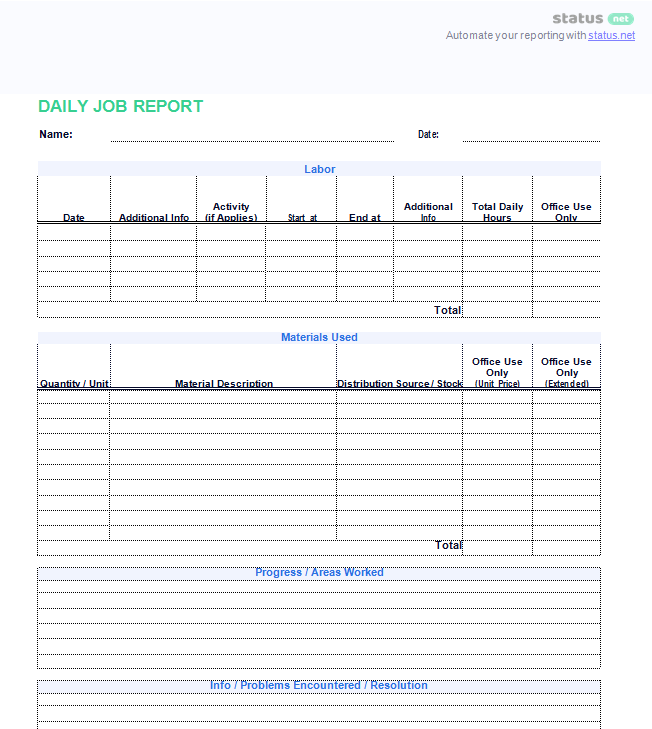
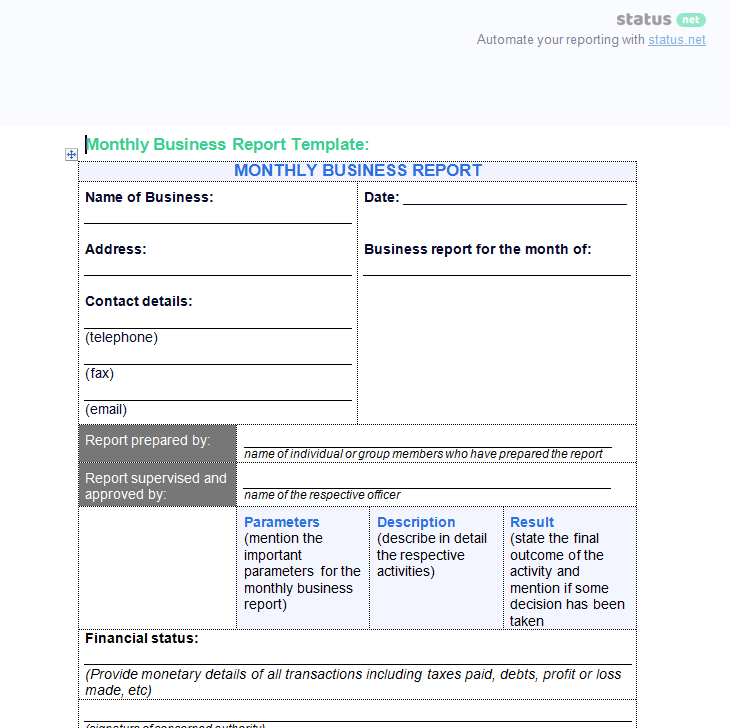
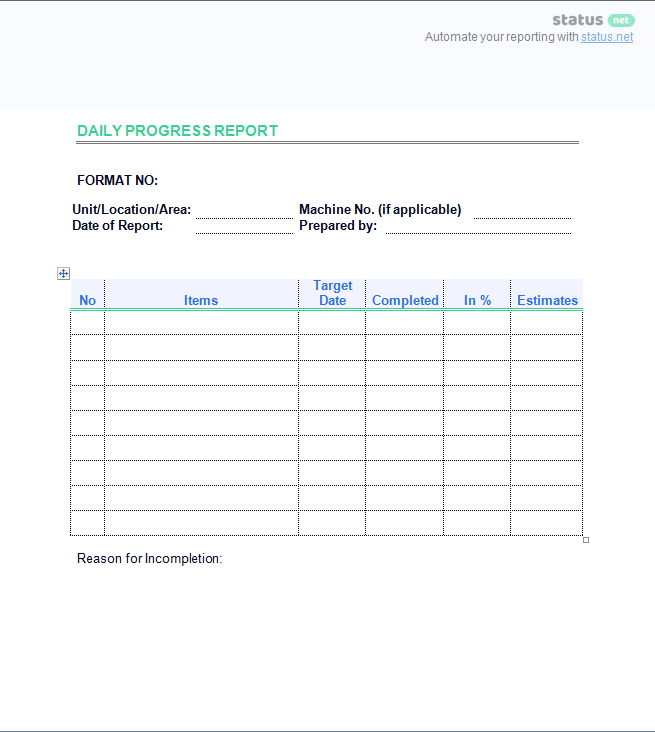
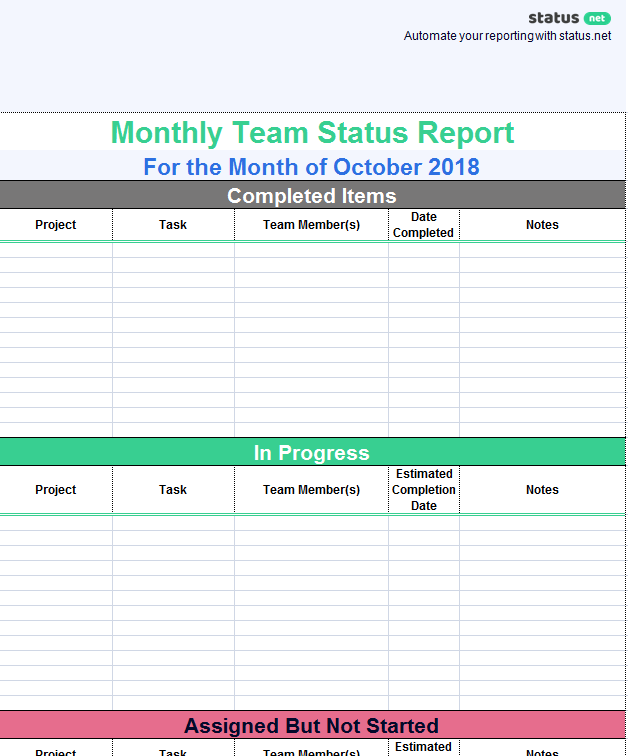
A good template does the thinking for you before the day even starts. Instead of staring at a blank page each evening, you fill in the same fields every time. At minimum, a solid daily work report format should include:
- Date and reporting period so the report can be filed and referenced later.
- Name and role of the person submitting it, especially useful once a supervisor is collecting reports from several staff members.
- Tasks completed, written as short, specific statements rather than vague summaries.
- Tasks in progress, ideally with a rough percentage or status so progress can be tracked over several days.
- Plans for the next day, which keep the employee and supervisor aligned on priorities.
- Issues, blockers, or challenges, along with any action already taken to resolve them.
- Notes or learnings, a small but valuable section for process improvements or ideas worth revisiting.
Daily Work Report Templates by Role
The downloadable template above works well as a general starting point, but many teams adjust the fields slightly depending on who is filling it out:
- Employee daily work report: keep the focus on individual tasks, hours worked, and any support needed from a manager.
- Staff daily work report: add a shift or location field, since staff reports are often used to track coverage across multiple sites or shifts.
- Supervisor daily work report: combine team output into totals, flag any staff member who needs support, and highlight risks before they escalate.
- Project manager daily report template: include milestone status, resource usage, and any schedule risk, since project reports are read with the timeline in mind.
- Work completion report: replace the “plans for tomorrow” field with a sign-off section confirming the task or project is finished and ready for review.
Choosing the Right File Format for Your Report
The DOCX template above works well for anyone who wants an editable, printable document. Depending on how your team collects reports, other formats can be a better fit:
- Word (DOCX): best when the report needs to be edited daily and stored as a running record.
- PDF: useful when the report is finalized and needs to stay locked, such as a signed work completion report shared outside the team.
- Spreadsheet (XLSX): a strong choice when a supervisor wants to track several days or several employees side by side, since rows and columns make it easy to spot patterns over time.
- Plain email or chat message: often the fastest option for small teams that do not need a formal document, as long as the same structure is used every day.
Part 2How to Write a Daily Work Report to Your Boss
Writing a report for a supervisor is a little different from writing one for your own records. The tone stays professional, the length stays short, and the structure needs to make it easy for a busy manager to scan the report in under a minute.
Daily Report Format to Send Your Boss
Most managers respond well to a format that follows this order:
- A short greeting and the date.
- A one-line summary of how the day went overall.
- Tasks completed, listed as bullet points.
- Tasks still in progress, with a status or percentage.
- Plans for the next working day.
- Any issues, blockers, or requests for help.
- A brief closing line inviting questions or follow-up.
This structure works whether the report is sent by email, posted in a team chat, or filled into a shared document. Keeping the order consistent every day helps a manager know exactly where to look for the information that matters most to them.
Sample Daily Work Report to a Boss
Here is a short example that follows the format above:
Subject: Daily Work Report – Maria Santos – March 12
Hi James,
Here’s a quick summary of today’s work:
Completed:
- Finished the client proposal draft and sent it for review
- Resolved the login issue flagged by QA
- Attended the 10 a.m. team sync
In Progress:
- Updating the onboarding guide (roughly 60% complete)
Plans for Tomorrow:
- Finalize the onboarding guide
- Start testing the new checkout flow
Blockers:
- Waiting on design assets from the marketing team
Let me know if you would like more detail on any of these.
Thanks,
Maria
Notice that every line is short and specific. A boss reading this can tell, in seconds, what happened, what is at risk, and what to expect tomorrow.
Email Etiquette for Sending Daily Reports
- Use a clear subject line such as “Daily Work Report – [Name] – [Date]” so the email is easy to find later.
- Send it at a consistent time, typically near the end of the working day, so your manager knows when to expect it.
- Keep the body scannable with short bullet points instead of long paragraphs.
- Flag urgent issues separately rather than burying them in the report; a genuinely urgent blocker often deserves its own message.
- Avoid over-explaining routine tasks. If a task is part of the normal workday, a single line is enough.
Part 3Daily Performance Reports Vs. Work Reports
A daily work report and a daily performance report often overlap, but they answer slightly different questions. A work report focuses on what was done. A performance report focuses on how well it was done against a target, quota, or benchmark.
- Daily work report: lists tasks completed, tasks in progress, and plans for the next day. It works well for most roles and is the easiest format to maintain consistently.
- Daily performance report: adds measurable indicators, such as sales figures, units produced, calls answered, or tickets resolved, and compares them against a goal.
- Work completion report: filed once, at the end of a task or project, to confirm that the work is finished and ready for review or handoff.
Sales teams, call centers, and production roles often benefit from adding a performance layer to their daily reports, since a manager reviewing dozens of reports at once can move faster when the numbers are already front and center. Roles with less repetitive, harder-to-quantify work, such as creative or strategic positions, tend to stay more effective with a straightforward task-based report.
Part 4Common Mistakes to Avoid in Daily Reports
- Being too vague. “Worked on project” tells a supervisor almost nothing. Naming the specific task, client, or deliverable makes the report useful.
- Writing too much. A daily report that takes more than a minute or two to read often gets skimmed rather than read carefully.
- Skipping blockers. Leaving out a problem to avoid looking behind schedule usually backfires, since the delay surfaces later anyway, often at a worse moment.
- Changing the format constantly. Switching structure from day to day makes it harder for a supervisor to compare progress over time.
- Forgetting the date or reporting period. Without it, reports become difficult to file, search, or reference weeks later.
- Submitting late or inconsistently. A report that arrives at random times loses much of its value as a planning tool for the supervisor.
Frequently Asked Questions
What is a work report?
A work report is a short, structured summary of tasks completed, work in progress, and plans for the near future. It is most often written daily and shared with a supervisor or manager, though weekly and project-based versions exist as well.
How do I write a daily work report to my boss?
Start with the date, then list what you completed, what is still in progress, your plans for the next day, and any blockers you need help with. Keep each line short and specific, and use the same structure every day so your manager can scan it quickly.
What should a daily work report include?
At minimum, include the date, your name or role, tasks completed, tasks in progress, plans for the next day, and any issues or blockers. Some reports also include a short notes section for learnings or process improvements.
How long should a daily work report be?
Most effective daily reports take less than a minute to read. A handful of bullet points under each section is usually enough. Longer, narrative-style reports tend to get skimmed rather than read in full.
What is the difference between a work report and a work completion report?
A work report is typically an ongoing, recurring document, often filed daily or weekly. A work completion report is filed once, at the end of a specific task or project, to confirm that the work has been finished and is ready for review.
Can I use the same daily work report template every day?
In most cases, yes. Reusing the same template builds a habit and makes it easier for a supervisor to compare progress across several days. Adjust the fields only if your role or reporting needs change significantly.
Should a daily work report include performance metrics?
Include metrics when your role has clear, countable outputs, such as sales calls, units produced, or tickets resolved. Roles centered on judgment-based or creative work often read better as a task-based report without forced numbers.
What is the best format for sending a daily report to a manager?
Email works well for most teams because it creates a searchable record. Shared documents or spreadsheets work better when a supervisor wants to compare several employees or several days side by side. Follow whatever format your manager already prefers, since consistency matters more than the specific tool.
How do I write a daily report if I have very little to report?
Report honestly. A short day with fewer completed tasks is still worth documenting, especially if it explains a blocker, a meeting-heavy schedule, or support given to a teammate. Padding the report with vague filler tends to be more noticeable than a brief, honest entry.
-
…
-
…
-
…
-
…
-

…
-
…